84. Crackpottery is Impedance-Mismatched Rigor 🔗
October 17, 2021
In which I defend Myers-Briggs and Strauss-Howe over Big Five personality science — arguing that crackpottery is impedance-mismatched rigor, that being wrong about the right things beats being precise about dubious constructs, and that empirical noise cannot resolve ontological ambiguity.
🔗
Astronomy >>> Astrology
Chemistry >>< Alchemy
…but
Big 5 << Myers-Briggs, Enneagram
Generational history < Strauss-Howe
It’s about whether you use empirical lenses to illuminate or obscure
Chemistry >>< Alchemy
…but
Big 5 << Myers-Briggs, Enneagram
Generational history < Strauss-Howe
It’s about whether you use empirical lenses to illuminate or obscure
🔗
The difference between astronomy and astrology isn’t that one is more empirical than the other. For much of history they were equally empirical. In fact arguably astrology required MORE rigorous and measurement and observation.
The diff is astronomy has sounder foundations.
The diff is astronomy has sounder foundations.
🔗
Chemistry over alchemy is less unambiguous. More an evolutionary maturity thing, Though both used similar measurement/observation, alchemy simply had a goal that turned out to be unfeasible using the methods they used. You just need a particle accelerator. Fact or Fiction?: Lead Can Be Turned into Gold | Scientific American
🔗
imo astrology is so fundamentally unsound (serious opinion here though I have fun with it), no improvement in techniques can make anything it says true . There’s no “particle accelerators” to be found there. So it is qualitatively worse than alchemy.
🔗
Now Big 5 vs Myers-Briggs/enneagram. So you think that Big 5 having “correlations” where they don’t makes it better?
Or that the fact you can easily learn to game MBTI to generate any result or that it will score differently depending on your mood makes them worse?
Or that the fact you can easily learn to game MBTI to generate any result or that it will score differently depending on your mood makes them worse?
🔗
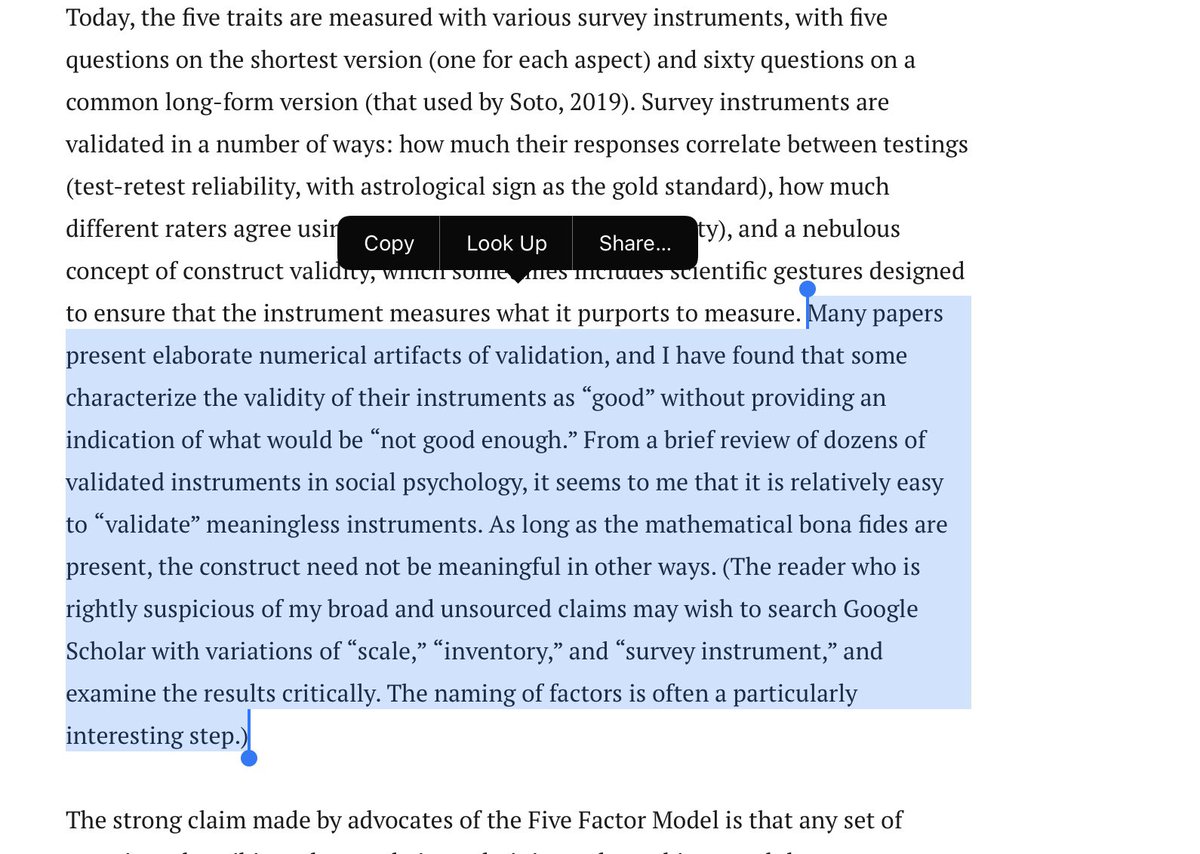
The empiricism is irrelevant because both are equally bad, resting on the lexical hypothesis (roughly, believing that words like “extraversion” point meaningfully to traits and can be measured with survey instruments). See @literalbanana essay The Ongoing Accomplishment of the Big Five – Carcinisation
🔗
If you think data are a basis for choosing the right system, think hard about whether you really should be measuring a spectrum labeled “introversion to extraversion” with p-values and things, and whether better numbers mean you understand the referents of the words better.
🔗
Note that this problem exists even in astronomy/astrology. It took a while for people to figure out that “morning star” and “evening star” both point to the planet Venus. Making words mean things in clear ways before measurements make any sort of sense is non-trivial work.
🔗
What’s the point of very precise morning/evening star position logs if you’re trying to compute 2 paths for 1 object in a geocentric system of spheres? Your ontology has an extra fictitious thing in it, and your scaffolding is highly suboptimal at least, and arguably wrong.
🔗
A trickier example: ancient Indian astronomy/astrology explained eclipses in terms of 2 demon “shadow planets” named Rahu and Ketu. It’s not clear what those proper nouns refer to. It’s not their demonic personification that’s the problem. It’s their ontological ambiguity.
🔗
Similarly alchemy era had its phlogiston, pre-relativistic physics had ether and elan vital, modern physics has dark matter. The presence of dubious elements is not the problem. It’s pretending they’re NOT dubious.
🔗
Or worse acting like empirical noise can make meaningless concepts meaningful. Ambiguity cannot be resolved by increasing empirical certainty. Higher resolution image won’t resolve the duck-rabbit illusion into clearly a duck or rabbit.
🔗
Philosophically rigorous fields progressively clean up ontology.
Philosophically sloppy and/or dishonest fields pretend increasing certainty about ambiguous things creates better truth.
Philosophically sloppy and/or dishonest fields pretend increasing certainty about ambiguous things creates better truth.
🔗
So why do I like Myers-Briggs better? Because given that what can be measured is nebulous-dubious-ambiguous, it’s actually useful to explore foundations conceptually rather than empirically. To go beyond using sketchy surveys to point to weasel words that point to some “traits”
🔗
There’s an entire “geocentric” theory of personality under the hood. Not just words pointing at each other and statistics. It’s at least trying to be about the world. It’s wrong in the right way. It has the right kind of history going back to Freud and Jung.
🔗
It has the right kind of ontological trajectory to eventually converge with neuroscience based thinking about the architecture of the brain rather than its socially embodied heat signatures. It’s a “Greek terms for fMRI ghosts” kind of wrongness. It’s wrong about the right things
🔗
Big5 otoh fundamentally isn’t interested in personality as a property of brains at all, anymore than astrology is interested in stars. Both are interested in influencing human affairs with whatever authority they can muster, at the most leveraged loci.
🔗
Astrologers wanted to influence how kings governed. Big5 wants to influence how bureaucrats govern. Both sought/seek ascriptive institutional authority by complicating techniques beyond amateur accessibility and create and protect exclusive access to power.
🔗
It is revealing that though Myers-Briggs has a sketchy private corp grifting at the heart of it, the ideas themselves are accessible to amateurs, not policed, and have roots in an older open tradition (Freud, Jung, all the way back to I Ching type divination). It’s honest.
🔗
The situation is even clearer in Strauss-Howe generational theory (and other cycle theories of history…, Turchin, hell even Kondratriev and Elliot wave theories).
Pointing to the detailed “noise” of history to criticize these things isn’t as impressive as you think.
Pointing to the detailed “noise” of history to criticize these things isn’t as impressive as you think.
🔗
Empirical data are always about some theoretical commitments and concepts. If you can’t articulate those commitments explicitly you can easily delude yourself that you’re doing phenomenology rather than “undeclared” (and usually terrible) theory.
🔗
Doing actual phenomenology is incredibly hard. It’s hard in the way meditation is hard. If you’re doing any kind of pre-theoretical quantitative studies, the chances are 99% (heh heh I measured this to 3-sigma!) that you’re doing undeclared theory, not phenomenology.
🔗
Numbers without clearly identified clean-edged concepts they’re about are a “tell” of pre-theory. There’s a reason meditation only involves ritual use of numbers at best, not actual math. If you’re doing statistics you’re doing theory, whether or not you know what theory it is.
🔗
The linguistic dimension of this whole line of thought is imo as important as the replication crisis on bad math and experimental design. Follow @literalbanana for this and read this seminal paper on the “generalizability crisis” where the trail starts OSF
🔗
I’m personally less interested in criticism of the bad research (good public service being done there) than in just learning to think better around alchemy-stage topics, where there’s a limit to available conceptual clarity and therefore to the value of empirical rigor.
🔗
I’m obviously not shy about this. My main stock-in-trade is obviously midwit-grade phlogistons like 2x2s, memes, weasel words like “strategy” and “mediocre” and so on. So how to play in this swamp without turning dishonest? How to avoid for eg temptation of “Big 5 of strategy”?
🔗
My main rule of rigor is: don’t load concepts with more stress than they can bear. Don’t run big surveys and do multiple regressions on a 2x2 invented in a shitpost. Explore it in jokes, free form essays, even fiction. This is a matter of both taste and honest intentions.
🔗
Taste is easy to cultivate with just practice. The hard part is avoiding temptations. If you want to land a big 6-figure consulting deal based on a proposal based on a shitpost 2x2… you’re guaranteed to add dishonest rigor to words and numbers.
🔗
Honest intentions here can be of 2 types:
1. Don’t succumb to temptation, keep it play
2. Admit it at least to yourself and own the grift. I can respect that.
What I can’t respect is fooling yourself that you’re doing rigorous, research while in denial about grifting
1. Don’t succumb to temptation, keep it play
2. Admit it at least to yourself and own the grift. I can respect that.
What I can’t respect is fooling yourself that you’re doing rigorous, research while in denial about grifting