80. Vegetarian Meal-Presentation 🔗
August 30, 2021
In which I argue that vegetarian cuisine is fundamentally parallel and random-access while meat is serial and hub-spoke — exploring why Western plating fails vegetarian food, how Indian thali and Ethiopian injera get it right, and the mise-en-place improv of non-meat-centered eating.
🔗
When high-end restaurants sometimes charge the same for comparable meat and vegetarian items, where the meat is clearly a more expensive ingredient… are they explicitly scheming to get vegetarians to subsidize the meat eaters? 🧐
🔗
You can tell when a meat eater has thought of a vegetarian dish. They always try to center a signature ingredient in a meat-like scheme. Usually large portobello mushroom, eggplant nedalki9n, beets, or recently, large chunks of cauliflower.
🔗
It’s… okay, but that’s really not how vegetarian cuisine works really. It’s not hub-spoke. More like a balance of 3-4 equally dominant elements. A good strategy is a protein, a starch, and a non-trivial veggie side.
🔗
Meat lends itself to an aircraft carrier group type assemblage. An ultradominant core with little things hovering around. The only vegetarian dish where I’ve seen that work well is good veggie burgers. Less frequently, slabs of tofu or tempeh can work.
🔗
garbled word is medallion 2 tweets up
I really dislike attempts to use vaguely meaty veggies in literal-minded meat substitute ways. I don’t like eggplant much, but if I had to eat it, a thick medallion in a Napoleon configuration is the worst form factor.
I really dislike attempts to use vaguely meaty veggies in literal-minded meat substitute ways. I don’t like eggplant much, but if I had to eat it, a thick medallion in a Napoleon configuration is the worst form factor.
🔗
And a large portobello as a burger substitute is the laziest idea ever. Slice it, create a melange with other ingredients.
I do think many meat-first chefs are genuinely interested in doing good, imaginative veggie food. They just lack veggie-first orientation.
I do think many meat-first chefs are genuinely interested in doing good, imaginative veggie food. They just lack veggie-first orientation.
🔗
Trad vegetarian-centric cuisines fail in a different way, by centering a starch. Works if you’re a farmer burning 4000 calories farming everyday, but coma-inducing for modern couch drones.
🔗
The worst veg option I’ve ever seen was at a Persian restaurant in Phoenix — the only thing was a vast pile of rice topped with dry kebab skewer veggies. Fortunately other Persian places do better, with stews.
🔗
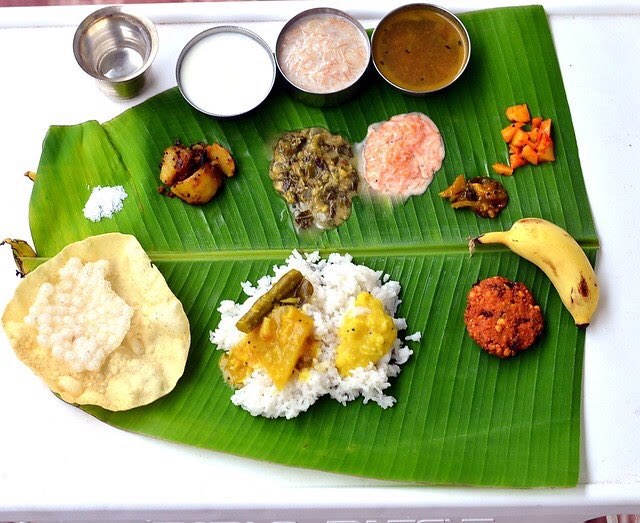
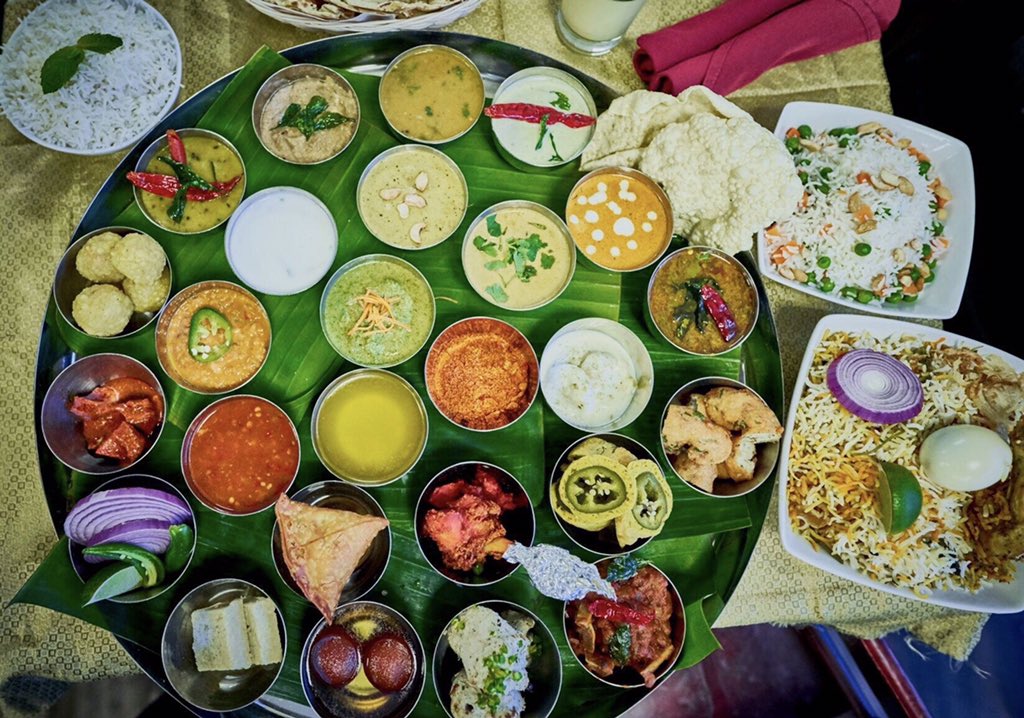
This is why even at weddings and such, the formal presentation of Indian food is highly parallel in a thali or plantain-leaf form. There are still 2-3 courses, but with like 10 things in parallel, and only 1-2 elements shifting. True even when meat is on the menu.
🔗
Bento boxes and Ethiopian injera based platters work the same way. Anytime meat is decentered, even in meat-heavy cuisines like middle-eastern, things go from serial to parallel.
🔗
For eg, the idea of a “salad course” makes no sense in a veg meal — a salad is a thread through the whole meal. You crunch a mouthful to vary the flavor. Papads are not appetizers. They are crunch elements beginning to end.
🔗
If you think Indian food is too mushy, it’s because you ate the papads and pakoras at the beginning. At an Indian wedding, you’ll be offered papads several times through the meal.
🔗
You may not be served things in the order you’re meant to eat them. For eg. in a south-indian plantain-leaf meal, pickles are served at the beginning in the ritual order in one corner, as is a bit of salt, but both are usually used at the end, to accompany the curd-rice course.
🔗
There’s an element of improv expectation. You’re served a mise-en-place rather than a scripted meal. You have to compose the meal yourself to some extent. Every bite can hit one of several notes. In a western serialized meal, it’s at most 2-3 choices (sandwich bite, chip, pickle)
🔗
I’m not sure how you’d actually do a restaurant to serve both ways at once, especially at the same table, but I suspect it’s solvable. 🤔
But it does require an element of diner education on alt norms. Like you don’t eat at a dim-sum or family style place the same way.
But it does require an element of diner education on alt norms. Like you don’t eat at a dim-sum or family style place the same way.
🔗
A thing I’ve noticed in Indian restaurants is people coordinating choices. Lighter, more snack-like meals tend to be more serializable (eg vada or pakoras followed by dosa or puri-bhaji). Either everybody will order thalis or everybody will order the lighter fare.
🔗
Did not expect to shitpost on culinary medium-is-the-message principles this morning, but in a bit of a food coma after eating a whole loaded bagel.
🔗
Hmm…, a simplified home meal in the western tradition is often a composed 1-course plate, with everything except desert, which looks like a thali. But a simplified Indian meal will eliminate threads rather than courses (eg only one vegetable but still 2 courses — roti and rice)
🔗
I think it’s because the courses do less work but more important work, like hot followed by cold which matters more in hot (and more likely to be veggie) climates.
🔗
One of the things I’m very curious about is how long it will take postmodern nutrition-hacking diets, based on equal parts bioscience, real science, and alchemy, to develop all the complicated nuances trad cuisines have kinda made tacit (but easily grokkable by inspection)
🔗
Here’s an interesting roundup of weird and interesting diets and theories from @dschorno. It’s had me thinking a lot the last few days.
From radical conspiratorial “everything is toxins” body-as-temple diets to weird stunt diets like croissants-only.
Bear Nation - by Drew Schorno
From radical conspiratorial “everything is toxins” body-as-temple diets to weird stunt diets like croissants-only.
Bear Nation - by Drew Schorno
🔗
Personally I enjoy food too much, and venerate body-as-temple too little to ever go full-stack nutrition hacker. I’m fine with body-as-trash-can. Otoh, I have no veneration for trad food ways either. They were once perhaps adaptive under varied patterns of privation, that’s all.
🔗
* broscience not bioscience 3 tweets up
I’ve definitely noticed effects of trying modern changes like cutting back carbs, increasing proteins, limiting/eliminating seed oils etc. But I’m broadly in the camp that argues that humans can thrive on a huge range of input mixes.
I’ve definitely noticed effects of trying modern changes like cutting back carbs, increasing proteins, limiting/eliminating seed oils etc. But I’m broadly in the camp that argues that humans can thrive on a huge range of input mixes.
🔗
Diseases of modernity probably have a few fairly specific causes like added sugar. I’m skeptical of theories and diets that demand really comprehensive revamps of entire diets, most of which have millennia of good-enough history and considerable old science behind them.
🔗
Like… the Central Americans figured out nixtamakization to make corn work?? Quite astounding scientific moonshot on what must have been a “disease of modernity” back in the day. Entirely non-obvious advanced chemistry hack. Nixtamalization - Wikipedia
🔗
So the history of nutrition is probably — treat the body as somewhere between temple and garbage pail, eat whatever doesn’t immediately kill you, address obvious “badness” caused by specific foods or deficiencies via processing or supplementation. Trust the evolved body.