18. External vs. Internal Locus of Control 🔗
December 9, 2018
In which I complicate the standard theory of locus of control by arguing that external-locus people run hot — not helpless — and that managing their explosive, outward-directed energy is the central unsolved problem of institutional design, from entrepreneurship to societal meltdowns.
🔗
There are 2 kinds of people: external versus internal locus of control (ELoC vs ILoC), based on how they tend to explain events, and whether they favor attributing external or internal factors. You can tell them apart by heat signatures of their responses to things going wrong.
🔗
I think the traditional theory of LoC is incomplete. It tempts you to conclude that ELoCs feel “helpless”and therefore act less energetically when things go wrong. No, in fact they act MORE energetically than ILoCs, who respond with restrained energy. Locus of control - Wikipedia
🔗
Yes, ELoCs think events can be explained by factors outside their control, but no they don’t react with helpless resignation. They typically ACT to either bring those factors into their control, or more commonly, try to forcefully influence those they see as having the control.
🔗
ELoCs run hot. When things go wrong, they tend to react with high-energy patterns targeting outside world, often angry/violent ones.
ILoCs run cold. When things go wrong they turn inward into deeper introspection low-energy patterns until they are barely alive.
I’m ILoC obv.
ILoCs run cold. When things go wrong they turn inward into deeper introspection low-energy patterns until they are barely alive.
I’m ILoC obv.
🔗
This is NOT extrovert/introvert. Both can be either ELoC or ILoC. Example, in Myers-Briggs terms, INTJs tend to be ELoC, but INTPs tend to be ILoC. It’s where you explain things (inside or outside) not where you “live”.
But misaligned E’s or I’s create extreme temperaments.
But misaligned E’s or I’s create extreme temperaments.
🔗
Speculative 2x2
ILoC+introvert = Chronic Depressive/bipolar
ELoC+introvert = Hikkikomori/cold-revenge server
ILoC+extrovert = Drama Queen
ELoC+extrovert = Chaosmaker
ILoC+introvert = Chronic Depressive/bipolar
ELoC+introvert = Hikkikomori/cold-revenge server
ILoC+extrovert = Drama Queen
ELoC+extrovert = Chaosmaker
🔗
ILoCs are well-understood because they tend to self-document exits from bad (low-energy) states in autobiographical writing. ELoCs help by supplying high-energy stimuli like dragging ILoC friends out of shells. People who like “introvert” memes are often actually ILoC extroverts.
🔗
Enough about ILoCs. We talk way too much about them. Let’s talk ELoCs.
ELoCs are often seen as “problem people” in bad situations because their “bad-state” responses are high-energy. You can ignore a low-energy ILoC fuck-up but an ELoC fuck-up demands management from others.
ELoCs are often seen as “problem people” in bad situations because their “bad-state” responses are high-energy. You can ignore a low-energy ILoC fuck-up but an ELoC fuck-up demands management from others.
🔗
This should be obvious from the definition. If someone tends to blame external factors and people for their suffering, there’s a good chance they’ll turn into problems for those blamed factors. ELoCs spread their pain around to make their problem everybody’s problem.
🔗
To the extent a problem is shared by a group, ILoCs tend to exit shared problems if nobody cares to “save” them. ELoCs otoh, if unmanaged by others, tend to become part of the problem, and further down the death spiral, bigger than the original shared problem.
🔗
When Churchill said “the only thing we have to fear is fear itself” he was thinking ELoCs. People who add energy to a problem whether or not they also add commensurate intelligence to help resolve it. Energy without intelligence is explosive energy.
🔗
ELoCs — External-locus-of-control people — are exhausting to be around. When down, they keep punching down harder and harder in a mean-spirited way, getting madder and madder. Only thing I know of that flips them to ‘nice’ is lining up a small skill-based win for them...
🔗
But then they turn around, get all holier-than-thou, and get madder and madder punching UP in a mean-spirited way. Lining up a small dose of luck turns them ‘nice’ again.
Keeping anELoC in a healthy band of generous-spirited motivation is hard.
Keeping anELoC in a healthy band of generous-spirited motivation is hard.
🔗
You have to feed them a steady stream of correctly calibrated “luck” and “merit-based wins” to stabilize. Since they NEVER turn inward to explain anything, only external stimuli work. I suspect cognitive-behavioral therapy fails on such people. They need pure behaviorism.
🔗
Or to put it another way, cognitive reframing etc are weak behavior change levers if there are very few frames to begin with, and they’re all mostly unconscious firmware. Their conscious frames are about modeling external factors. Mostly external “people” factors. Blame frames.
🔗
Don’t get me wrong. ELoCs are an important part of healthy societal problem solving. They bring all the energy and the focus on external factors needed if indeed that’s the locus of the problem. They are the ‘unreasonable’ people all change depends on.
🔗
But when they “break bad”, especially on wicked problems with big internal AND external contributing factors, ELoCs, who are probably the majority, can turn cancerous. They bring change energy to the party with no good ideas. Result: things go BOOM!
Societal meltdowns.
Societal meltdowns.
🔗
Introverted ELoCs are particularly dangerous since they can seethe in resentment for years, accumulating energy, until they finally blow up. Often described as a “silent majority.” Probably better described as “ticking time bombs.”
🔗
If you are ILoC and have ELoCs in your life you will learn to manage them with merit-win+luck game-making, and they’ll swing between hating/thanking you for it. That’s your cross to bear. They’ll return favor by pumping you up when you’re low-energy. That’s their cross to bear.
🔗
But at macro scale things are much harder. ILoCs never cause collective level problems because they retreat, self-isolate. But ELoCs can connect, feed off each other and turn into explosive metastasized societal problems. True believer mobs etc. ILoCs can’t easily “manage” this.
🔗
An ILoC at the end of his rope is likely to commit suicide. If the cause is external, ultimate failure mode of looking internal is to run out of life energy in isolation.
ELoCs too, commit suicide at the end of their rope, but like to take as many people with them as possible.
ELoCs too, commit suicide at the end of their rope, but like to take as many people with them as possible.
🔗
This is the fundamental asymmetry of LoC sociology. During general bad times, full of both internal and external factors driving multiple wicked problems, you get both a suicide epidemic AND an epidemic of suicide-bombing type events. The latter is the bigger problem.
🔗
In fact a great deal of societal/institutional design is devoted to ELoC management: making sure ELoC introverts have safe outlets so they don’t accumulate “Cold Revenge” energy, and ELoC extroverts have zones to act where chaosmaking is an asset, like entrepreneurship.
🔗
Institutional failure is almost always ELoC containment failure. ELoC introverts connecting and blowing up. ELoC extroverts turning to crime or cult leadership (there’s a Baumol paper about the latter).
We’re in a condition of near ELoC meltdown right now.
We’re in a condition of near ELoC meltdown right now.
🔗
I don’t have answers here yet, but I think this is the question next-gen institutional design (my current big interest) has to answer: How do we control and manage ELoC energy so it powers society steadily instead of blowing it up every decade.
🔗
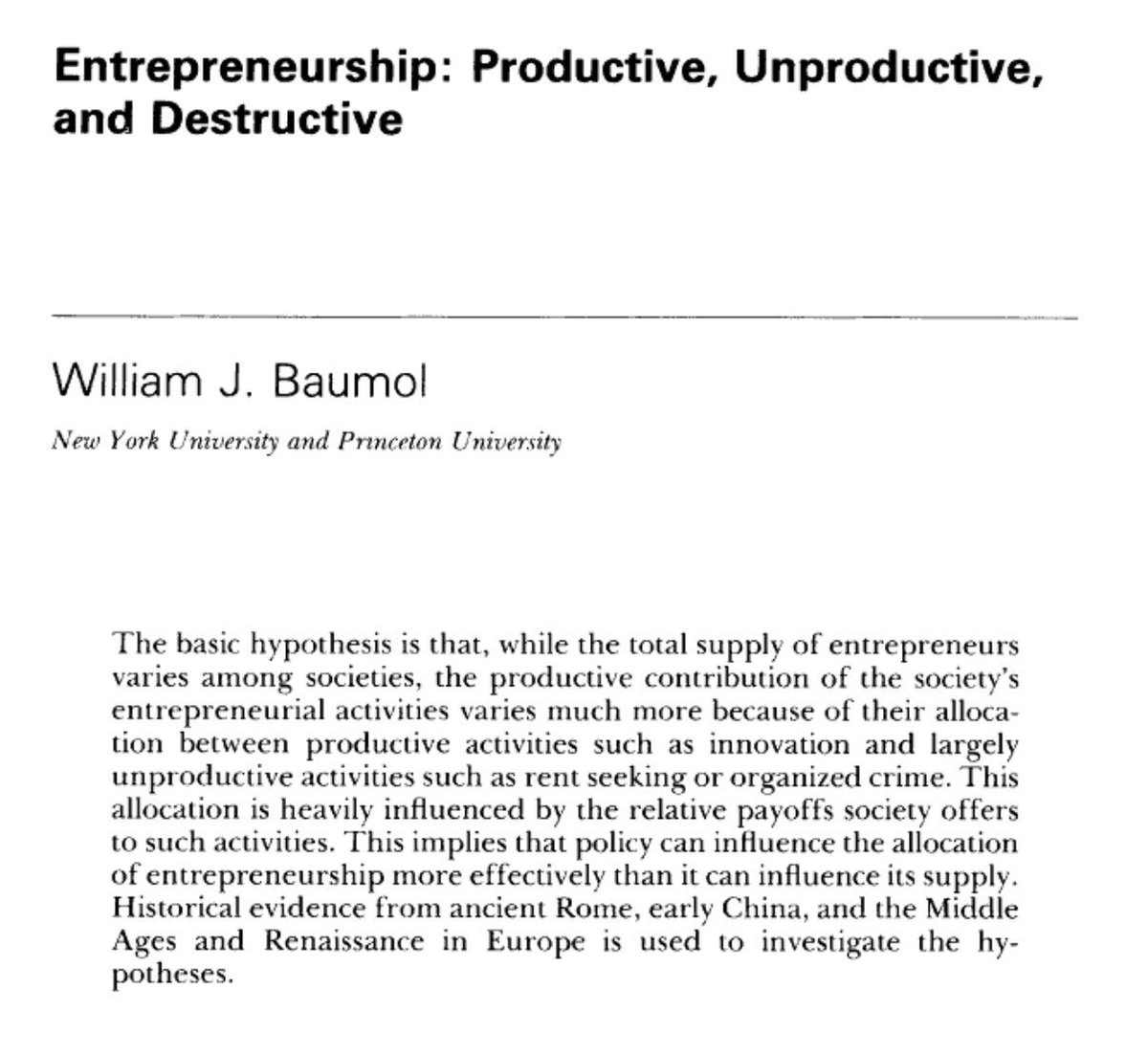
Baumol paper I mentioned: “Entrepreneurship: Productive, Unproductive, and Destructive”
Entrepreneurship: Productive, Unproductive, and Destructive on JSTOR
Entrepreneurship: Productive, Unproductive, and Destructive on JSTOR